

Why Price Per Square Foot Does Not Tell the Whole Story in Paradise Valley
David Newman · August 27, 2026
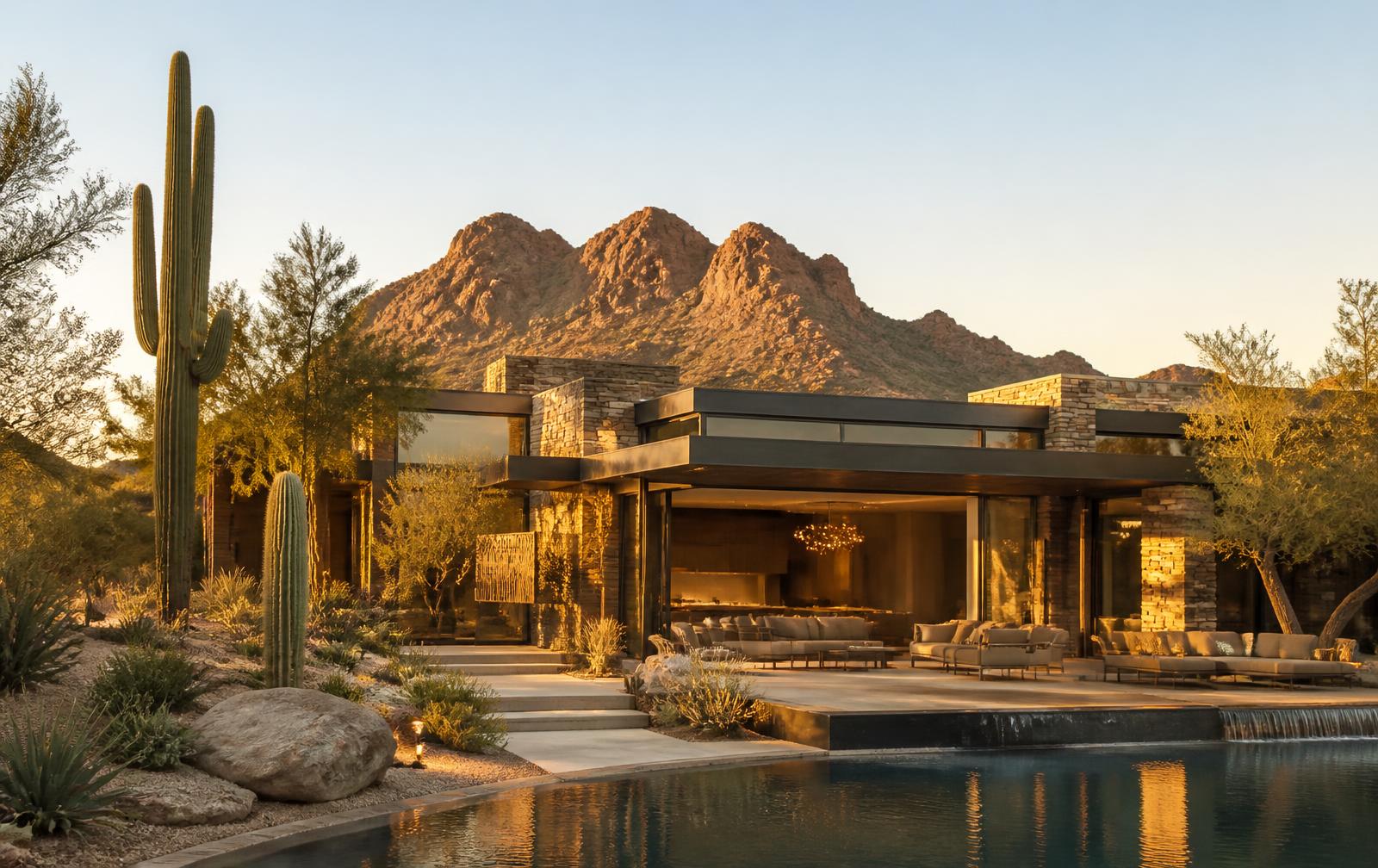
The short answer
Price per square foot can provide helpful context, but Paradise Valley luxury homes are too property-specific to be valued accurately by one average. A home's lot, views, architecture, condition, privacy, location within Paradise Valley and underlying land value can create substantial differences between two properties that look similar on paper. Treat the figure as one data point, not the answer.
Key takeaways
- Price per square foot is one reference point, not a valuation method.
- In Paradise Valley the land can carry a significant share of the value.
- View quality, orientation and privacy change which buyers compete for a home.
- Added square footage does not automatically add proportionate value.
- A property-specific analysis is more reliable than any single average.
Why Price Per Square Foot Can Be Misleading in Paradise Valley
Price per square foot is a simple calculation: a sale price divided by the home's living area. It is easy to quote, easy to compare and genuinely useful for orientation. It also assumes that a square foot in one home is equivalent to a square foot in another.
In Paradise Valley that assumption breaks down quickly. The calculation does not account for:
- Lot size and usable area
- Lot quality, grade and orientation
- Mountain and city-light views
- Privacy from neighbors and roadways
- Architecture and design quality
- Renovation level and finish quality
- Age, condition and mechanical systems
- Location within the town
- Guest houses and detached structures
- Outdoor living, pools and landscape
- The underlying value of the land
In a production housing market, homes are similar enough that averages behave reasonably well. Paradise Valley is the opposite: highly individual properties, built across many decades, on lots that differ from one another in ways that materially affect value. The more unique the property, the less an average describes it.
In Paradise Valley, Start With the Land.
Before evaluating the house, it is worth understanding the site. Lot characteristics can influence value as much as anything inside the walls.
- Total acreage and how much of it is genuinely usable
- Flat versus sloped or hillside terrain
- Buildable area and setback constraints
- Privacy and separation from adjoining homes
- Orientation, sun exposure and where the outdoor living faces
- Road exposure, noise and access
- Washes, drainage and natural features
- Position relative to the mountains
- The character and condition of surrounding properties
- Redevelopment or expansion potential
Two homes of the same size can sit on very different sites — one on a private, largely flat acre with protected outlooks, the other on a smaller parcel with limited usable yard and closer exposure to a busier street. Divided by square footage, they can appear comparable. They are not.
There is also a category of buyer whose interest is weighted toward the land itself. Depending on the property, that may lead to a cosmetic remodel, a substantial renovation, a significant addition or, in some cases, new construction on the site. This is not a judgment about older homes — many Paradise Valley residences are exceptional and are bought to be lived in as they are. But where a site is unusually strong and a residence no longer suits current buyer expectations, land value can become the more relevant measure, and a per-foot comparison drawn from renovated homes will describe neither property well.
A View Is Not Just a View.
Views are frequently reduced to a yes-or-no field in a data sheet. In practice they are far more granular, and buyers respond to the differences.
- Which mountain is in frame — Camelback, Mummy Mountain or another silhouette
- How close and how prominent the mountain reads from the primary living spaces
- City-light exposure in the evening
- Whether the view corridor is broad or narrow
- How much of the outlook is obstructed by neighboring rooflines or mature vegetation
- Whether the view feels protected from future change
- Which direction the backyard and main terraces face
A home whose principal rooms open to an unbroken mountain silhouette attracts a different buyer pool than an otherwise similar home with a partial or interrupted outlook. When a property appeals to a narrower but more motivated group, both the pace and the outcome of a sale can change. That is a positioning difference, not a square-footage difference.
Buyers Pay for More Than Square Footage.
Architecture and condition are the second place where averages fall apart. Market response tends to vary with:
- Contemporary architecture versus older Southwest and territorial styles
- Whether the design reads as timeless or of a particular era
- The quality and completeness of any remodel
- Ceiling heights, proportion and natural light
- Floor plan logic and how the home lives day to day
- The strength of the indoor-outdoor connection
- Kitchen and primary bath quality
- Roof, mechanical systems and infrastructure
- Visible deferred maintenance
Adding square footage does not necessarily add equivalent value. A large home with a dated plan, low ceilings and an unresolved renovation can trade below a smaller residence that is beautifully designed, well built and genuinely finished. Buyers at this level are not purchasing volume — they are purchasing a specific experience of a specific property.
A smaller exceptional home can outperform a larger dated one. The ratio will never show you that.
Paradise Valley Is Not One Uniform Market.
Value also varies by where a property sits within the town. Averages calculated across all of Paradise Valley blend conditions that a buyer experiences as very different.
- The street itself and how it is traveled
- The immediate surroundings and the estate character of nearby homes
- Proximity to the mountains and elevation on the site
- Traffic and noise exposure
- Privacy at the entry and in the outdoor living areas
- Lot orientation relative to sun and view
- Nearby construction or redevelopment activity
- Convenience of access to the surrounding area
Our broader overview of the town — including how buyers evaluate it and how we represent property there — is on the Paradise Valley luxury real estate page.
A Better Valuation Looks at the Property as a Whole.
A meaningful valuation begins with data and then adjusts for the property in front of you. David Newman Partners considers:
- Recent comparable sales, adjusted rather than averaged
- Current competing inventory a buyer would see at the same time
- Lot characteristics and usable land
- View quality and orientation
- Architecture and design
- Condition, systems and renovation level
- Underlying land value
- Present buyer demand for this type of property
- How the property should be positioned and to whom
- Timing within the selling season
The strongest comparable is often not the nearest sale or the one closest in square footage. A home two streets away with a similar lot, similar view corridor and a comparable level of finish will usually tell you more than the house next door with a different site and a different level of renovation. Twenty-five years working in this market is largely useful for that judgment: knowing which sales actually inform a value and which ones only look like they should.
If you would like that analysis for your own property, request a private property valuation.
The Same Analysis Helps Protect a Buyer's Future Equity.
Buyers sometimes treat a lower price per square foot as evidence of a better purchase. It may be — or it may simply reflect what the property is.
- A weaker lot or limited usable land
- Dated condition or an incomplete remodel
- Road exposure or reduced privacy
- Architecture with narrower appeal
- Compromised or obstructed views
- Significant renovation requirements ahead
A higher figure can be equally rational when it reflects land, position, views or architecture that would be difficult or impossible to recreate. Those attributes tend to hold their appeal for the next buyer, which is the practical meaning of protecting future equity: buying qualities that endure rather than paying for square footage that does not.
David's perspective
In luxury real estate, averages can be useful, but they can also create false confidence. Two homes can be similar in size and still be completely different properties. In Paradise Valley, I want to understand the land, the views, the architecture, the condition and who the likely buyer will be before deciding what the home is worth.
Related questions on this subject
Is price per square foot important in Paradise Valley?
It is useful as one reference point for orientation, but not as a valuation method. It should be read alongside lot quality, views, architecture, condition, privacy, location and land value.
Why do Paradise Valley homes have such different prices per square foot?
Because the properties themselves differ. Lot size and usability, view quality, privacy, architecture, renovation level, condition and the underlying value of the land all vary widely from one home to the next.
Does a larger Paradise Valley home always sell for more?
No. Size alone does not determine value. A smaller, well-designed and well-finished home on a strong lot can sell for more than a larger residence with a dated plan or deferred maintenance.
How important is land value in Paradise Valley?
It can be a significant component of value, particularly where the lot is unusually strong or where renovation, expansion or new construction is a realistic path for the next owner.
How do I find out what my Paradise Valley home is worth?
Through a property-specific analysis. Automated estimates and broad price-per-square-foot averages cannot see your lot, views, architecture or condition, which are usually what separate your home from the comparable sales.

Author
David Newman
Arizona luxury residential real estate
25 years in Arizona real estate and approaching $1 billion in sales, concentrated in Paradise Valley and Scottsdale luxury property.
Questions people ask next
- Do views affect luxury home value?
- What makes one Paradise Valley street more valuable than another?
- Does a remodel always increase value?
Related insights
Have a specific question about your property or your search?
Every property is different. A short conversation is usually more useful than a general answer — and it carries no obligation.